MEV Bot Strategies for BNB Chain (2026 Guide)
**Answer first** — The most viable MEV strategies on BNB Chain in 2026 are PancakeSwap V3 concentrated liquidity arbitrage and Venus Protocol liquidations. BNB's 3-second block tim
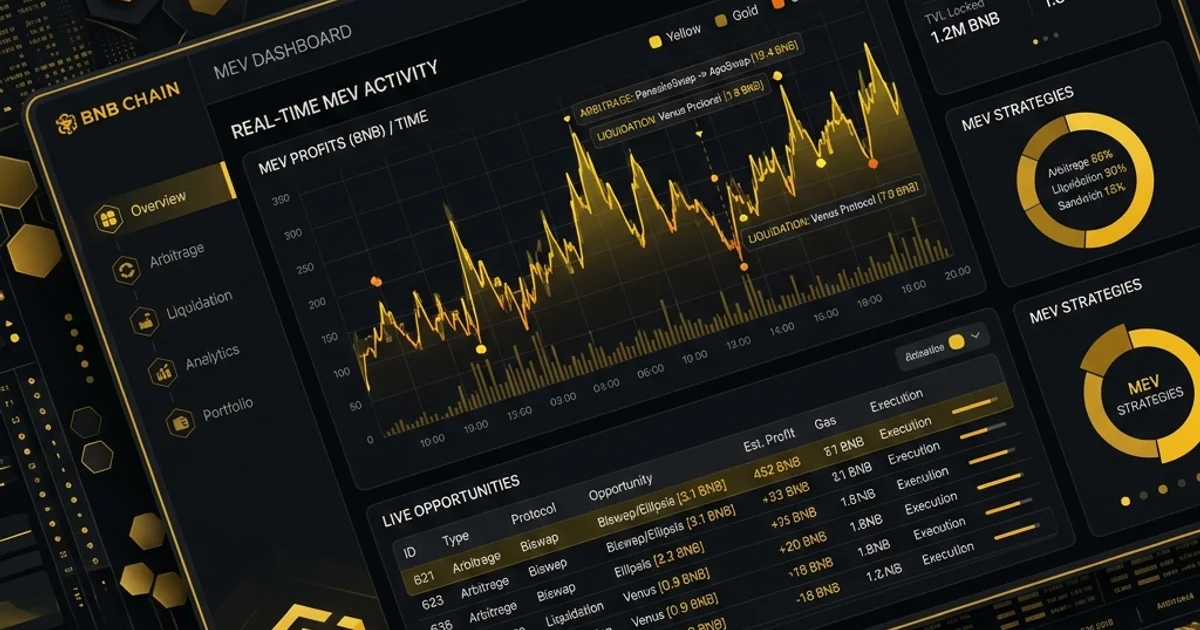
Answer first — The most viable MEV strategies on BNB Chain in 2026 are PancakeSwap V3 concentrated liquidity arbitrage and Venus Protocol liquidations. BNB's 3-second block time creates a high-frequency environment where execution speed matters more than on Ethereum, and the lower gas costs mean smaller absolute opportunities can still be profitable. The key infrastructure requirement is low-latency WSS endpoints co-located near BNB Chain validators — Singapore and Frankfurt are the primary regions. This guide covers the three main strategies, their execution requirements, and how BNB Chain's characteristics differ from Ethereum MEV.
Mastery Path: BNB Specialized Path
- BNB Chain Routing Tips
- MEV Bot Strategies for BNB (Current)
- MEV Bot Comparison
- Chain MEV Hub
BNB Chain's MEV Environment in 2026
BNB Chain (formerly Binance Smart Chain) operates with different dynamics than Ethereum L1:
3-second block times — four times faster than Ethereum's 12-second slots. This means your detection-to-submission pipeline needs to operate in under 500 ms to be competitive, compared to several seconds on Ethereum.
Lower gas costs — transaction fees on BNB Chain are typically $0.05–$0.50 per transaction, versus $5–$50+ on Ethereum L1. This lower friction enables profitable extraction on smaller opportunities, increasing the frequency of viable trades.
High retail trading volume — PancakeSwap remains one of the highest-volume DEXes globally, driven by retail traders accessing the Binance ecosystem. Retail-heavy flow produces more predictable price-impact patterns than institutional-dominated markets.
Less sophisticated private relay infrastructure — BNB Chain does not have an equivalent to Ethereum's Flashbots private bundle system. Most MEV operates through priority fee competition on the public validator selection process. Some validators accept private bundle submissions, but coverage is inconsistent. FRB automatically detects which submission path is available and falls back to public mempool submission when private relay is unavailable.
Higher competition at the lower end — BNB Chain's low gas costs attract more MEV bots, including lower-quality automated scripts that wouldn't be viable on Ethereum. This creates more noise but also more opportunity to outperform poorly-optimized competitors.
Strategy 1: PancakeSwap V3 Concentrated Liquidity Arbitrage
PancakeSwap V3 introduced concentrated liquidity in 2023, allowing liquidity providers to concentrate capital in narrow price ranges. This creates arbitrage opportunities that didn't exist in V2 AMMs.
How concentrated liquidity arbitrage works:
In a standard V2 AMM, price impact is smooth and predictable. In V3, when a large trade moves the price across a liquidity tick boundary, the effective price jumps discontinuously. The price in the tick being crossed is different from the price in the adjacent tick.
When a retail trade moves the PancakeSwap V3 price into a low-liquidity tick range, the effective exchange rate diverges from what BiSwap or PancakeSwap V2 shows for the same pair. This spread is your arbitrage margin.
Execution requirements:
- Real-time monitoring of PancakeSwap V3 pool state, specifically tick-level liquidity distribution
- Fast enough execution to submit a correction trade before other arbitrage bots detect and close the spread
- At minimum: Singapore-based WSS endpoint with under 80 ms median latency to BNB Chain validators
Typical opportunity profile:
- Spread above profitability threshold: 0.1–0.5% (after fees from both pools and BNB gas)
- Trigger: retail trade of $5,000–$50,000 moving price into a tick with thin liquidity
- Window duration: 1–5 seconds before competing bots detect and close the spread
Key pairs to monitor: BNB/USDT, CAKE/BNB, ETH/BNB (cross-chain pricing creates recurring divergence), BTCB/BNB.
Strategy 2: Venus Protocol Liquidation Sniping
Venus Protocol is the primary lending protocol on BNB Chain with $500M+ in TVL as of 2026. When borrowers' collateral values drop below the required threshold, their positions become available for liquidation — and the liquidator receives a 5–10% bonus on the repaid amount.
How BNB Chain liquidations work:
Unlike Ethereum where Aave liquidations often involve flash loans and complex multi-step execution, Venus on BNB allows direct liquidation calls: supply the repayment asset, receive the collateral plus the liquidation bonus, in a single transaction.
The timing challenge:
Venus uses oracle price feeds that update on a heartbeat schedule (typically every 5–10 minutes for small price moves, more frequently for large moves). During volatile periods, positions become undercollateralized in real terms before the oracle confirms it on-chain.
Your bot needs to:
- Monitor borrower health factors using the current market price (not the oracle price)
- Estimate when the oracle will update based on the divergence threshold
- Submit the liquidation transaction to arrive in the block immediately after the oracle update
Execution approach:
- Subscribe to Venus oracle contract events via WSS to detect oracle updates in real time
- Pre-compute which positions become liquidatable at different price levels so your bot is ready to submit immediately when the price threshold is crossed
- Use a high priority fee on the liquidation transaction to win sequencing position in the first block after the oracle update
Capital requirements: Venus liquidations require holding the repayment asset. If you're liquidating a BNB-collateralized position with USDT debt, you need USDT in your worker wallet to repay. Flash loan integration is possible but adds execution complexity.
Minimum practical allocation per liquidation: $5,000–$20,000 in repayment capital to capture meaningful liquidation bonuses.
Strategy 3: PancakeSwap V2 Backrunning
PancakeSwap V2 remains active despite V3's launch, particularly for CAKE ecosystem pairs and smaller-cap tokens. The V2 AMM's constant product formula makes backrun opportunities straightforward to calculate.
Why backrunning instead of sandwiching:
Sandwiching in 2026 is viable on BNB Chain where there's no Flashbots-style builder filtering — but it's operationally difficult. Successfully sandwiching requires your frontrun transaction to land before the victim's transaction and your backrun to land after, in the same block, with precise gas pricing. The margin for error is narrow and failed sandwich attempts waste gas.
Backrunning is simpler and less risky: you wait for a large swap to execute, then capture the resulting price discrepancy without touching the original transaction. The opportunity is guaranteed by the trigger trade; you only compete on speed for the correction trade.
Target swap size for profitable BNB Chain backrunning:
- V2 pairs with high TVL ($5M+): profitable at swap sizes above $20,000
- V2 pairs with medium TVL ($500K–$5M): profitable at swap sizes above $5,000
- V2 pairs with low TVL: spreads are large but absolute profit is small; high risk of slippage eating the margin
BNB Chain vs. Ethereum: Key Operational Differences
| Feature | BNB Chain | Ethereum |
|---|---|---|
| Block time | 3 seconds | 12 seconds |
| Gas cost per arb | $0.10–$0.50 | $5–$50 |
| Private relay infrastructure | Inconsistent | Mature (Flashbots, Titan) |
| Minimum profitable opportunity | ~$500 swap | ~$5,000+ swap |
| Competition density | High (many low-quality bots) | High (sophisticated bots) |
| Primary MEV venues | PancakeSwap V2/V3, Venus | Uniswap V3/V4, Aave, Curve |
The lower gas costs on BNB Chain mean you can profitably extract from smaller opportunities — but also that more bots compete for those smaller opportunities. The competitive dynamic is different from Ethereum: on BNB you're frequently beating unsophisticated bots through better latency and simulation, whereas on Ethereum you're competing with professional searcher teams.
Infrastructure Configuration for BNB Chain
WSS endpoint requirements:
- Singapore (SIN) or Frankfurt (FRA) POP — these regions have the lowest latency to BNB Chain validator infrastructure
- Target P95 latency under 200 ms from your execution server to the WSS endpoint
- At least two backup endpoints on different providers — BNB Chain's forked RPC providers sometimes throttle without warning
Use the WSS Latency Tester to benchmark your endpoints before committing to live execution.
FRB Agent configuration for BNB:
- Settings → Networks → switch to
BNB Chain - Input your primary Singapore or Frankfurt WSS URL
- Enable
FallbackToPublic: truefor BNB specifically — BNB Chain validators don't universally support private relay, so public mempool fallback is expected behavior, not a security risk on this chain - Set gas multiplier to
1.3×of current base fee — BNB Chain gas competition requires more aggressive bidding than Ethereum - Configure session budget cap and refund guard before enabling live execution
Keeping backup endpoints warm: BNB Chain providers are more prone to silent throttling than Ethereum providers. Maintain a secondary endpoint with low-rate traffic to prevent cold-start delays when your primary endpoint throttles. Monitor endpoint response rates in Ops Pulse and configure automatic rotation if throttling is detected.
Risk Controls Specific to BNB Chain
Honeypot exposure is higher on BNB Chain — BNB Chain has seen more honeypot contracts than Ethereum because its lower gas costs make deploying traps cheaper. FRB's simulation pipeline includes BNB-specific honeypot pattern detection, but you should also:
- Only trade pairs that have been active for more than 7 days
- Set minimum liquidity thresholds ($100K+) before including a pair in your monitoring list
- Review any new pairs manually before adding them to automated strategy coverage
Venus liquidation competition: Venus liquidations attract intense competition during volatile periods. Your gas bid needs to be at the 90th percentile of recent successful liquidation transactions to reliably land in the first block. FRB's dynamic fee calculator uses the Venus liquidation history to calibrate bids automatically.
Allowlist enforcement: BNB Chain has had multiple DEX router exploits. Configure FRB's router allowlist to include only PancakeSwap V2/V3 official routers and Venus contract addresses. Never route through unverified aggregators or unofficial forks. See the BNB MEV guide for the current verified router addresses.
Summary
BNB Chain offers accessible MEV opportunities with lower capital requirements than Ethereum L1, but requires faster execution infrastructure due to 3-second block times. The three primary strategies — PancakeSwap V3 tick arbitrage, Venus liquidations, and V2 backrunning — each have distinct profiles suited to different capital sizes and risk tolerances.
Start with simulation, verify your WSS latency, configure gas and budget caps before going live, and treat BNB Chain as a separate operational venue from Ethereum with different parameters and different risk exposures.
Download FRB Agent and configure BNB Chain in simulation mode before committing capital. The free MEV guide covers cross-chain strategy sizing if you're running BNB alongside other chains.
Step after reading
Launch FRB dashboard
Connect your wallet, pair the node client with a 6-character PIN, and assign the contract mentioned above.
Go to /appNeed the installer?
Download & verify FRB
Grab the latest installer, compare SHA‑256 to Releases, then follow the Safe start checklist.
Open install guideCheck Releases & SHA‑256Related Articles
Further reading & tools
Discussion
No notes yet. Add the first observation, or share the link with your team on X (@MCFRB).