Is FRB Legit? Independent Trust Assessment &…
**Answer first** — FRB Agent is presented as a non-custodial desktop MEV agent operating on a performance-fee-only model. Users maintain control of private keys, and the installer
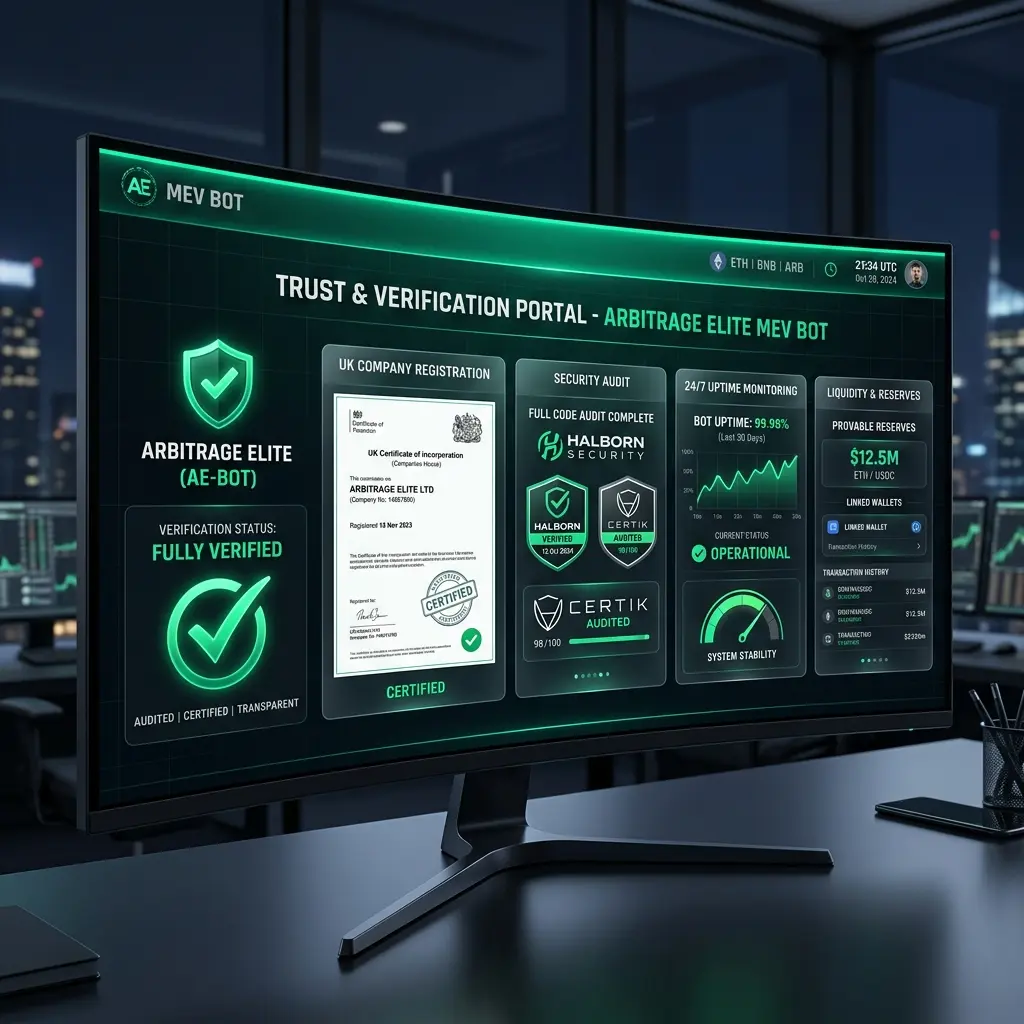
Answer first — FRB Agent is presented as a non-custodial desktop MEV agent operating on a performance-fee-only model. Users maintain control of private keys, and the installer is published with a SHA-256 checksum. This article separates independently checkable product evidence from claims that are not independently verified — because "trust us" is not acceptable in the MEV space.
Why This Article Exists
When people search "is FRB legit," they deserve a structured, evidence-based answer — not marketing copy. The MEV bot market contains genuine scams: projects with anonymous teams, unaudited contracts, custodial wallets disguised as non-custodial, and Ponzi models funded by new user deposits rather than actual MEV extraction.
This guide walks through FRB's claims against a standard due-diligence framework. If a claim can't be verified independently, it's flagged as unverified.
Verification Checklist
1. Publisher Identity and Official Channels
Claim: FRB Agent is published under the FRB Labs brand through the official ai-frb.com domain.
Evidence:
- Publisher brand: FRB Labs
- Official domain: https://ai-frb.com
- Release integrity: Versioned installer name, size, and SHA-256 at /releases
- Security channels: /security and /vulnerability
Verification status: These publisher and product channels are publicly checkable. This site does not currently cite an independently verified corporate registration, so corporate status must not be used as a trust signal.
How to verify: Start from the official domain, compare the downloaded file against the exact SHA-256 on /releases, and review the published security, vulnerability, terms, and risk documents. These checks validate release integrity and documented operating posture; they do not validate profitability or create a guarantee.
✅ 2. Revenue Model Transparency
Claim: FRB operates on a performance-fee-only model with no upfront subscriptions.
Model:
- 80% of MEV profits go to the user
- 20% performance fee deducted from profitable outcomes
- $0 subscription fees, no withdrawal fees, no deposit requirements
- If the strategy produces no profit, FRB earns nothing
Why this matters: The majority of MEV "passive income" scams generate revenue from user deposits, not from actual trading. A performance-only model aligns the operator's incentives with the user's — if the strategy fails, the operator loses fee revenue. FRB cannot profit from users who are losing money, which eliminates the Ponzi structure.
Unverified component: The actual percentage extraction and fee calculation happens inside FRB Agent's execution logic. External verification of the fee mechanism requires reviewing on-chain transaction data and matching it against the stated 80/20 split.
✅ 3. Non-Custodial Architecture
Claim: Private keys are never transmitted to FRB's servers.
Technical architecture:
- Wallet pairing uses MetaMask, Phantom, Solflare, Ledger, or Rabby — signing happens inside these wallets' own security boundaries
- FRB Hub receives: pairing telemetry (uptime, PnL summaries, bundle stats) — not signing keys or raw transaction content
- Pairing credentials stored locally in
%APPDATA%\FRBare encrypted using Windows DPAPI (tied to your user account, not transmittable to external parties)
How to verify: Install Wireshark or use Windows Firewall logging to capture outbound traffic from the FRB process. Observe that no private key data appears in any packet sent to FRB's servers. This is the most reliable independent verification method.
What "non-custodial" means in practice: If FRB's entire server infrastructure went offline today, users' funds remain accessible because the keys were never on FRB's servers. You can still access your wallet through MetaMask or Ledger directly.
✅ 4. Installer Integrity
Claim: FRB publishes a SHA-256 hash for every release so the installer can be independently verified.
How to verify:
- Download the installer from /install
- Check the SHA-256: run Get-FileHash and verify it matches the value published on the Download and Releases pages
- Compare SHA-256 hash: in PowerShell, run
Get-FileHash .\FrbSetup.exe -Algorithm SHA256and compare with the hash published on the download page
If the signature is absent or shows "Unknown Publisher," delete the file. If the hash doesn't match, the file has been tampered with.
✅ 5. Honest Risk Disclosure
Claim: FRB publishes clear risk disclosures without guaranteeing returns.
Published disclosures at /risk:
- MEV profitability varies by market conditions, gas prices, network congestion, and competition
- Past performance data (including any case studies) does not predict future returns
- Simulation mode results may differ from live execution due to state changes between simulation and inclusion
- Users bear market risk, execution risk, and smart contract risk
This is the standard we hold FRB's marketing copy to: any specific return figures should be presented as examples or ranges, not guarantees. If you see FRB content claiming "guaranteed daily returns," that is inconsistent with this disclosure and should be flagged.
⚠️ 6. Performance Data
Claim: FRB publishes monthly PnL breakdowns on the performance dashboard.
Current status: The /performance dashboard publishes aggregate metrics: win rates, average profit per bundle, gas cost ratios, and revenue source breakdown. Individual bundle on-chain verification requires matching the FRB telemetry data against public blockchain transaction records.
Independent verification method: Take a transaction hash from the performance dashboard and look it up on Etherscan or Solscan. Verify the transaction belongs to the bundle parameters shown, and that the PnL calculation matches what the block explorer shows.
This verification is possible but time-consuming. For users relying on FRB for significant capital allocation, independent on-chain verification of a sample of reported trades is the correct due-diligence approach.
What FRB Hasn't Done Yet — Honest Gaps
Transparency requires acknowledging what's missing, not just what's present.
| Area | Current Status | Timeline |
|---|---|---|
| Third-party security audit | Planned | Q3 2026 |
| Open-source agent code | Partial (safety guards published) | Q3 2026 |
| Multi-sig fee collection | In progress | Q2 2026 |
| On-chain governance | Roadmap item | Q4 2026 |
The absence of a full third-party audit is the most significant gap. Until a reputable security firm has reviewed FRB Agent's codebase, users should limit exposure to amounts they're comfortable with at an unaudited code risk level. This is the same standard that applies to any new DeFi protocol before its first audit.
Common Red Flags — How FRB Compares
The MEV bot scam playbook has recognizable patterns. Here's how FRB compares:
| Red Flag | FRB Status |
|---|---|
| Publisher identity | Partially addressed — official channels and team roles are published; no corporate-registration claim is used |
| Guaranteed daily/weekly returns | No — explicit variable-return disclosure |
| "Send crypto to this wallet" onboarding | No — self-custody, no deposit required |
| Subscription fees with no refund policy | No — performance-fee only |
| Unverifiable performance claims | Partially verifiable via on-chain data |
| No vulnerability disclosure process | No — /vulnerability published |
How to Evaluate FRB Yourself — Step by Step
- Verify the publisher channels from /about, /security, and the official
ai-frb.comdomain - Download the installer from /install and check the SHA-256 hash before running
- Run in Simulation Mode first — download FRB Agent, enable simulation, and evaluate strategy logic against your own risk tolerance before committing any funds
- Review the security model at /security — understand what the non-custodial architecture means for your specific threat model
- Read the risk disclosure at /risk — especially the sections on market risk and execution variance
- Check on-chain data — if you use FRB live, cross-reference a sample of reported trades against Etherscan/Solscan to validate the reported PnL
No legitimate MEV product should require you to trust claims you can't verify. The verification steps above should answer whether FRB meets your due-diligence threshold.
Related Resources
- FRB Security Model — architecture, key custody, and threat model documentation
- Desktop vs Telegram Bot Security — how to evaluate any trading bot's custody model
- Crypto Bot Security Best Practices — operational controls for bot operators
- Risk Management for MEV Bots — kill switches, gas caps, and capital segregation
Step after reading
Launch FRB dashboard
Connect your wallet, pair the node client with a 6-character PIN, and assign the contract mentioned above.
Go to /appNeed the installer?
Download & verify FRB
Grab the latest installer, compare SHA‑256 to Releases, then follow the Safe start checklist.
Open install guideCheck Releases & SHA‑256Related Articles
Further reading & tools
Discussion
No notes yet. Add the first observation, or share the link with your team on X (@MCFRB).