Base MEV Guide 2026: Automated Trading…
**Answer first** — MEV on Base in 2026 is dominated by cross-DEX arbitrage on Aerodrome Finance and Uniswap V3, plus lending liquidations on Morpho and Moonwell. Base's Coinbase-op
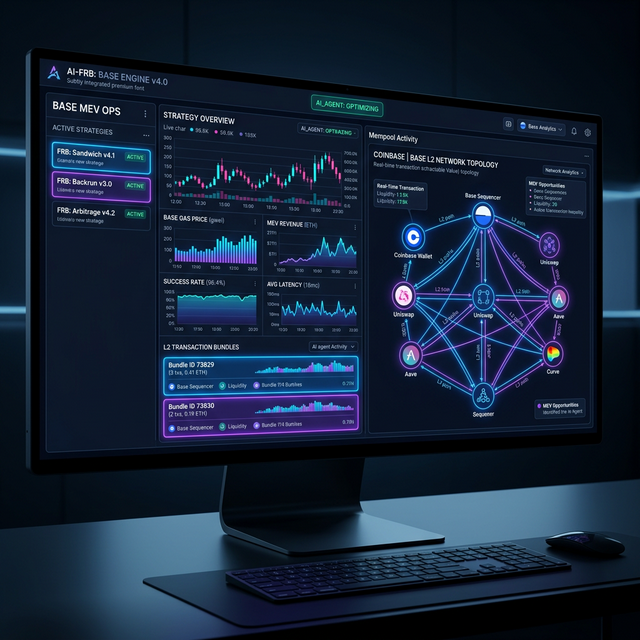
Answer first — MEV on Base in 2026 is dominated by cross-DEX arbitrage on Aerodrome Finance and Uniswap V3, plus lending liquidations on Morpho and Moonwell. Base's Coinbase-operated sequencer means there's no traditional private mempool — transaction ordering is determined by priority fee and arrival time. Success requires co-location near the sequencer (AWS us-east-1), fast WSS endpoints, and tight gas bidding logic. For systematic operators, Base offers lower per-trade margins than Ethereum L1 but significantly higher frequency — 400+ successful arbs per day is achievable with the right setup.
Mastery Path: Layer 2 Mastery
- Arbitrum MEV Latency
- Base MEV Strategies (Current)
- Optimism Playbook
- Reth RPC Mastery
- Base Playbook: First Private Bundle
The Base Execution Environment
Base is an Optimism-stack L2 launched by Coinbase in 2023. As of 2026, it uses a single centralized sequencer operated by Coinbase for transaction ordering, with Ethereum L1 as the settlement and data availability layer.
What this means for MEV:
No traditional private mempool — unlike Ethereum where Flashbots provides a clear private relay pathway, Base doesn't have an equivalent private bundle system from the sequencer operator. All transactions are ordered publicly by priority fee and time-of-arrival. This is planned to change as Base decentralizes — watch the Base blog for sequencer updates.
Priority Gas Auctions (PGA) are the primary ordering mechanism — whoever pays the highest priority fee gets sequenced first. This creates a competitive gas bidding environment rather than the atomic bundle model on Ethereum L1.
Sequencer location determines your competitive position — the Coinbase sequencer infrastructure runs in AWS us-east-1 (Northern Virginia). A co-located server in the same data center has a fundamental latency advantage over any remote competitor. This is not a soft advantage; at the transaction level, a 10 ms advantage translates to consistent first-sequenced position in contested windows.
Ethereum-equivalent tooling — Base uses standard EVM compatible smart contracts. Your Solidity arbitrage contracts, FRB Agent configuration, and Ethereum-compatible wallets all work on Base without modification, other than gas and contract address changes.
Top MEV Strategies on Base (2026)
1. Cross-DEX Arbitrage: Aerodrome Finance
Aerodrome is the dominant DEX on Base by volume and TVL. It uses a ve(3,3) tokenomics model with weekly gauge votes determining liquidity incentives. This creates predictable liquidity distribution shifts that produce arbitrage opportunities at predictable times.
The opportunity: Aerodrome's gauge weight changes happen weekly at epoch resets. Liquidity moves between pools in the hours following an epoch change, creating price discrepancies between Aerodrome and Uniswap V3 Base pools for the same pairs.
Execution pattern:
- Monitor Aerodrome's epoch reset timestamp (every Thursday 00:00 UTC)
- Pre-position monitoring on the top 10 pairs by volume in the 2 hours before reset
- Detect price divergence above 0.15% (after accounting for both pools' fees and your gas cost)
- Submit a high-priority fee transaction buying on the cheaper venue and selling on the more expensive venue simultaneously
Key pairs to monitor: ETH/USDC, WETH/cbETH, ETH/DAI, USDC/USDbC, and the top veAERO gauge pairs by weekly bribe volume.
2. Liquidations: Morpho and Moonwell
Base has a growing lending ecosystem with Morpho (curated vaults), Moonwell (Compound-forked lending), and Aave V3. Liquidation opportunities arise when collateral values drop faster than price feeds update, creating windows where positions are technically undercollateralized but not yet liquidated.
The mechanics:
- A borrower's ETH collateral value drops 8% during a volatile period
- Morpho's oracle hasn't updated in 90 seconds (oracle heartbeat delay)
- Once the oracle updates, the position's health factor drops below 1.0
- Your bot submits a liquidation transaction in the same block as the oracle update
Why oracle timing matters: The most competitive liquidation bots monitor oracle contract events directly, not just on-chain price feeds. When the oracle contract's price update transaction enters the sequencer queue, your liquidation transaction needs to be in the same block, positioned immediately after the oracle update using a higher priority fee.
Capital requirements for liquidations on Base: Morpho liquidations require you to provide the repayment capital upfront (flash loans are available to reduce capital requirements). Minimum practical allocation is $5,000–$20,000 per position to capture meaningful liquidation bonuses (typically 5–10% of the liquidated amount).
3. Uniswap V4 Hook Arbitrage
Uniswap V4 launched on Base in 2025 with its hook architecture, which allows custom logic to execute before and after swaps. Some hook implementations create exploitable price discrepancies compared to standard V3 pools for the same pairs.
The pattern: When a V4 pool's hook logic produces different effective prices than a corresponding V3 pool (due to dynamic fee adjustments, tick-based rebates, or hook-triggered rebalancing), a brief arbitrage window exists that standard price-scanning bots miss because they don't simulate hook execution.
This is a long-tail opportunity — most pairs don't have V4 deployments with meaningful TVL yet, and each hook contract requires custom simulation logic. But competition density is low compared to standard V3 arb, which means margin capture rates are higher.
Infrastructure Configuration for Base
WSS Endpoints
Base runs on Ethereum-equivalent infrastructure. The standard recommendation for Ethereum WSS selection applies, with the additional constraint that your endpoint should have low latency to Coinbase's sequencer infrastructure in us-east-1.
Use the WSS Latency Tester to benchmark:
- Target P95 latency: under 160 ms for competitive execution
- Jitter: under 20 ms — variance is more important than absolute latency on Base's fast sequencing
- Key providers: Alchemy (Base-specific tier), QuickNode (Base dedicated node), or self-hosted Base node (Optimism stack) co-located in us-east-1
FRB Agent Configuration for Base
- In the FRB Dashboard, switch the target network to
Base(Settings → Networks) - Paste your dedicated Base WSS URL
- Under Gas Strategy, select Aggressive Sequence mode — designed for single-sequencer L2 environments where PGA is the ordering mechanism
- Set
MaxGasGweito 110% of the current network base fee as a dynamic ceiling - Configure per-strategy session budgets before enabling live execution
Gas Bidding Strategy
On Base, the sequencer orders by effective gas price (base fee + priority fee). Your bid needs to be high enough to win the sequencing position you need without overpaying on opportunities where speed is less critical.
For liquidations (speed-critical): Bid at the 95th percentile of recent successful liquidation transactions. One missed liquidation can cost more than the gas overpayment from 100 successful ones.
For DEX arbitrage (latency-competitive): Bid at the 75th percentile. Arbitrage margins allow more headroom to reduce gas spend since you're competing with co-location rather than pure bid level.
Canary Launch Protocol
Follow this sequence before committing full capital to Base strategies:
Day 0: Install FRB, verify installer hash (see /install), pair one Base WSS node, configure Ops Pulse alerts.
Day 1: Simulation only — let FRB's simulation engine run the target strategy for 24 hours and review synthetic inclusion rates and projected PnL.
Day 2: Canary live — 10% of intended allocation, limited to the single highest-confidence pair identified in simulation.
Day 3–5: Review Ops Pulse — inclusion rate target >70%, refund rate target <15%. If metrics are clean, scale to 25% allocation.
Week 2+: Gradual scale with documented approval at each 25% increment.
See the Base Playbook for the full checklist and reporting templates.
Upcoming Changes: Base Decentralization
Coinbase has publicly committed to decentralizing Base's sequencer. When multi-sequencer or community sequencer models launch, the MEV dynamics will shift — private bundle infrastructure similar to Ethereum Flashbots may become available, which would fundamentally change the optimal strategy mix.
Monitor the Base blog and FRB's blog for updates when sequencer architecture changes are announced. The current PGA-focused approach may need to be supplemented with bundle-submission strategies once the infrastructure exists.
Related Resources
- Base Ecosystem Guide — chain-specific routing, relay configuration, and compliance notes
- Chain MEV Hub — comparison matrix across all supported chains
- Profitability and Gas Budget Guide — sizing caps for Base strategies
- Try EVM Demo — live mempool simulation on Ethereum (Base simulation available in upcoming FRB release)
Step after reading
Launch FRB dashboard
Connect your wallet, pair the node client with a 6-character PIN, and assign the contract mentioned above.
Go to /appNeed the installer?
Download & verify FRB
Grab the latest installer, compare SHA‑256 to Releases, then follow the Safe start checklist.
Open install guideCheck Releases & SHA‑256Related Articles
Further reading & tools
Discussion
No notes yet. Add the first observation, or share the link with your team on X (@MCFRB).